This is a build post — the practical companion to two ideas I’ve written about before: the Idea / Verifiability Matrix and causal-chain reasoning. You don’t need either to follow along. If you’re curious about AI but a little put off by the hype, this is the small, honest version of what it can actually do.
Task → Idea
I love books. I mean, really love books. My long term dream is to make a living reading and analyzing and writing about reading and writing and analyzing. I’d happily spend days in a windowless room with books. To that effect, I’ve put together two bookcases in my office, packed two-deep in places with tomes, growing quietly now for well over a decade. They’ve been acquired online, in bookstores, at garage sales, and even a few I found next to rubbish bins with forlorn notes of “Looking for a good home” and “Gently loved with plenty more to give” like they were orphaned puppies.
What I didn’t have, was a comprehensive list. Nothing fancy, just title and author of the copies I own. Deduplicated. Easy enough work: go through, write things down, put it in an excel list, make sure there aren’t duplicates. It’s the kind of dull, useful chore that sits on a to-do list for years because it’s too tedious to ever actually start.
And honestly, it’s the kind of chore that would drive me insane. I’d start, run across a title that I hadn’t seen in years, open to a few pages…and there goes the day. I’d forget where I started, or be irked by the lack of organization, and find myself in an irresistibly infinite loop of literary temptation.
“Pete and Re-Pete sit in a boat. Pete falls out. Who’s left? Repeat.”
Fuck that. We have magic now. So, I put on my wizard hat and thought: Can AI even do this? It can. It’s the most ordinary kind of AI task there is, and it’s exactly where most people should jump right in and play around.
But, how do I know if it works? Will it just make stuff up? How would I know if it did?
Those are the right questions. There’s a framework to going about it that I reference in It Was Us All Along. Let’s apply it here.
Start
Simple enough: I took twenty photos of the shelves and handed them to Claude with a plain instruction: count, inventory, deduplicate. As a safeguard, I also asked it to “only give me titles, authors, and ISBNs you’re confident about. Flag any uncertainties.” This was a safety mechanism: if I got a 100% confident list, I knew it didn’t work. There should be some level of uncertainty.
The Guardrail
The first reply wasn’t a list. It was a pushback.
I’d asked for the ISBN of each specific copy. The AI told me, plainly, that it couldn’t do that part — and why. “The barcodes visible on some spines were ThriftBooks store stickers, not ISBNs. Spine photos don’t carry the edition data you’d need to pin down a specific printing.” AI could give me title and author reliably, but fabricating 200+ ISBNs and presenting them as fact would be — in its own words — “the exact mistake that erodes trust.” Spicy.
This is the Idea / Verifiability Matrix playing out in real time. The task I’d handed over was actually two tasks wearing one sentence:
- “Read the title and author off the spine.” I can glance at the photo and check it instantly. High clarity, high verifiability. This is the quadrant where AI is a genuine force multiplier — and it was.
- “Tell me the exact ISBN of this copy.” I think I can describe what I want, but neither of us can verify the answer from the photo. The information isn’t in the image. Any number it gave me would look perfectly plausible and be unfalsifiable until I physically picked up the book.
Without the additional safeguard wording (only give me titles, authors, and ISBNs you’re confident about. Flag any uncertainties), the AI could have filled that ISBN column with 200 confident, wrong numbers, and I’d never have known — potentially ever. This is a fairly low stakes use-case where the effort of verifying the data defeats the purpose of the task: I wanted AI to build the list because I don’t want to build the list…I’m intentionally lazy about this. The useful move was to name the quadrant and hand that piece back to me with two honest options: scan the barcodes yourself, or let me look up likely ISBNs clearly flagged “verify against your copy.” It left the column blank rather than poison it.
That’s one practical lesson. The value isn’t that AI knows everything. It’s that a good one knows what it can’t verify and is guided, by you, to say so.
Human In The Loop
The first inventory came back grouped by subject, deduplicated across all the overlapping photos — and with ten titles flagged as low confidence. Blurry spines, partial reads, books wedged behind other books: classic book lover behavior.
Instead of guessing and burying the guesses in a clean-looking list, it quarantined them in their own section and told me which were shaky.
So I tried something I’d seen in the movies. I asked it to overlay numbered boxes around the uncertain titles in the original photos and send them back, so I could reply with the right titles. For 200 books, nope. For 10? Sure, I’ll get up and walk over. With the images overlaid, I knew where to look and could validate quickly.
“Enhance. Enhance.” — Super Troopers
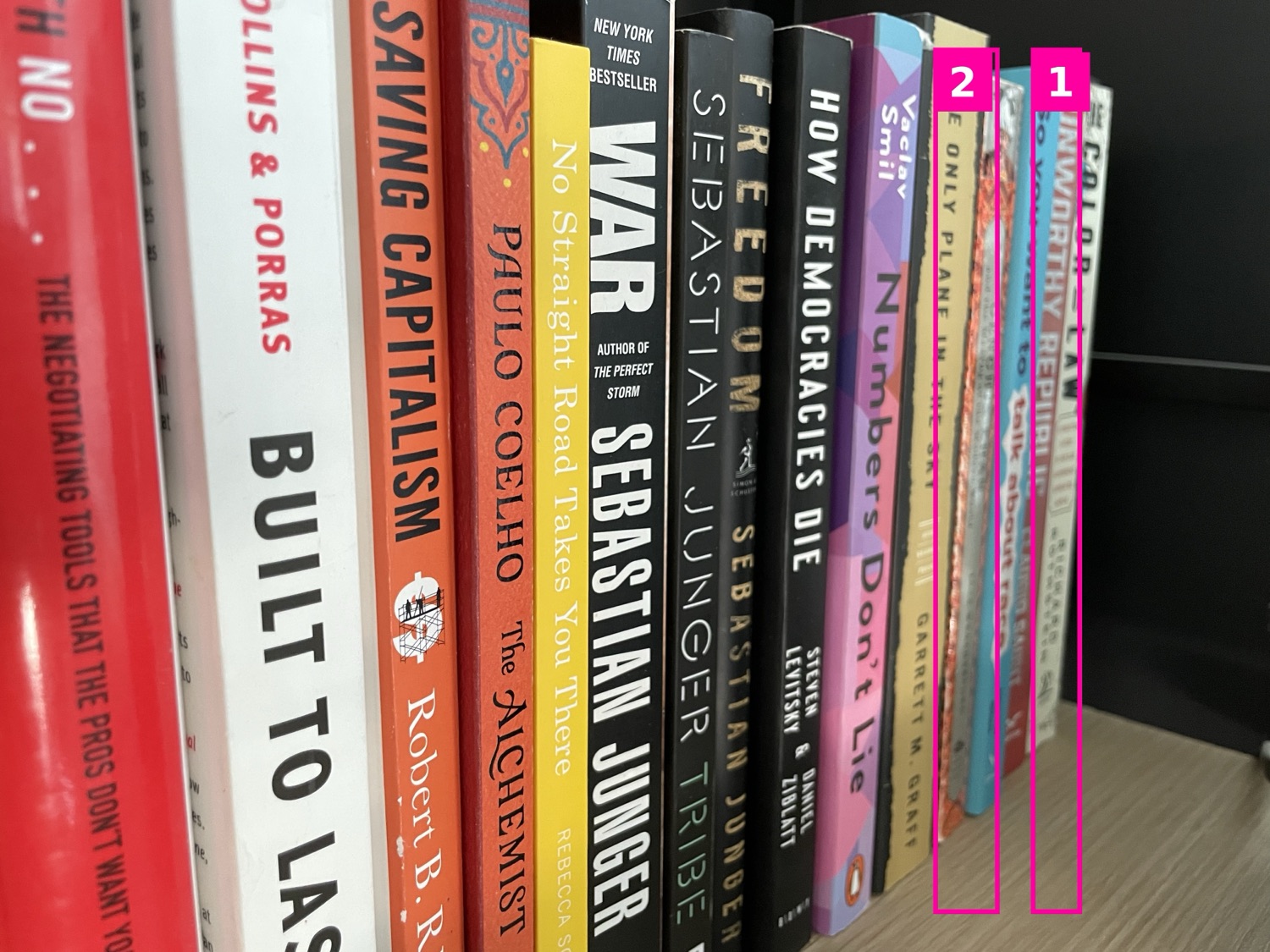
This is the part I’d point a skeptic to. Not the flashy output — the loop. The machine did the fast, tedious 95% (reading 200 spines across twenty overlapping photos), then drew a precise box around its own uncertainty and asked a human to close the gap. I confirmed titles. I corrected a few. I told it that two books it had merged were actually two separate books I genuinely own — a Lovecraft manga adaptation and a short-story collection that happened to sit next to each other. It split them back apart. One box turned out to be my personal journal; another, a misprint.
That’s causal-chain thinking turned into a workflow. In Most People Stop at Step One I argued that the rare skill is tracing a thing upward past the first obvious step. Here the AI did the inverse and just as valuable move: it traced its own output back down to “which exact pixels am I unsure about,” and made that uncertainty something I could act on. Confidence you can audit beats confidence you have to take on faith.
Fin: A Portrait
I read a lot. Obvious. I’m also aware that what I read is a reflection of my interests, influences, and what catches my eye on any given day. The kind of physical analog to “digital pocket litter” I wrote about in Cortex: Is the Promise Fulfilled? What does my reading say about me? So, yes, I asked Claude. I told it to generate insights into my reading shelf and then output them as web page with four views, all interactive. I even told it to surprise me. Again, we stuck to the upper right quadrant of the Idea Matrix: concrete idea (analyze a specific list under the premise that reading is a reflection of the person) with a verifiable output in the form of a web page with different visualizations. This is exactly where AI shines.
- What the shelf is made of counts pages, not spines — because a single doorstop history occupies more of your actual attention than three thin paperbacks. Flip it to title-count and the ranking visibly reshuffles.
- The reading marathon lets you drag in your own reading speed. At a normal pace, reading every page already on those shelves — about 25 million words — is roughly 74 days without sleep, or a steady ~290 minutes every single day for a year.
- Six centuries on one shelf plots each book by when its ideas were first published. Seventy percent is post-2000, yet the oldest voice on the shelf was speaking ~1,890 years before the newest.
- The barbell plots every book from pure-systems to pure-humanities. Mine isn’t a bell curve with a fat generalist middle — it’s two dense clumps with a thin waist. A builder at one end, a historian at the other, and almost nothing in between. I’d never have guessed that about myself. The data did.
The Actual Point, for the AI-Curious
If you’ve been watching the AI conversation from arm’s length, unsure whether it’s magic or a clever illusion, this project is the honest middle.
AI will not read your mind, and you shouldn’t believe otherwise. The best applications of AI do three unglamorous things extraordinarily well: it does the tedious 95% fast, it draws a clean box around uncertainties, and, if you keep pushing the work toward a verifiable end goal, it’ll produce results that generate value to you and others.
If you want to poke at the result, the full interactive lives here. Drag the reading dial. Flip the treemap. See what a decade of someone’s attention looks like from the outside.