Most weeks, grocery shopping does not fail in some dramatic way. It just leaks time.
I shop at a rotating cast of places depending on what we need and what kind of errand day it is: Meijer, Target, Market District, Costco, CVS, and whatever else makes sense that week. That sounds normal because it is normal. The annoying part is that every trip comes with the same low-level decision tax: where should I actually buy this stuff?
So I do what most people do. I check one app, then another. I search for items. Multiple times, multiple ways.
I raid the pantry and the fridge for information.
I eat things.
I try to remember which store usually had the better price on yogurt, strawberries, butter, bread, or whatever else is on the list.
I spend way too much time on a task that happens every week and should be simpler than it is: the constant tiny act of recomputing where to buy the same kinds of things over and over again.
At some point I got tired of being the human middleware between my grocery list and five different stores.
I have Codex. It promises to replace me.
I decided to call the bluff. So I built a grocery tracker.
The rule was simple: no new system
I did not want to create a whole new habit just to solve this problem.
That mattered more than the app itself.
I already keep my grocery list in Things. Whatever solution I concoct had to respect that. Things is useful, it’s light, I’m molded to it and bonded through repetition like that stain on your favorite chair from wiping your fingers after eating chips far too many times.
So the objective was simple:
I add grocery items to Things, the same way I normally do. Then I run an app to get a breakdown of where I should buy the items on my list.
Codex cranked it out in a day. Things CLI, API research, browser tools, design considerations, Javascript libraries, more. I clicked “Approve” and “Yes, don’t ask again” all too slowly like the expendable carbon sack I am promised to become.
And it worked. It even added some fancy visuals:
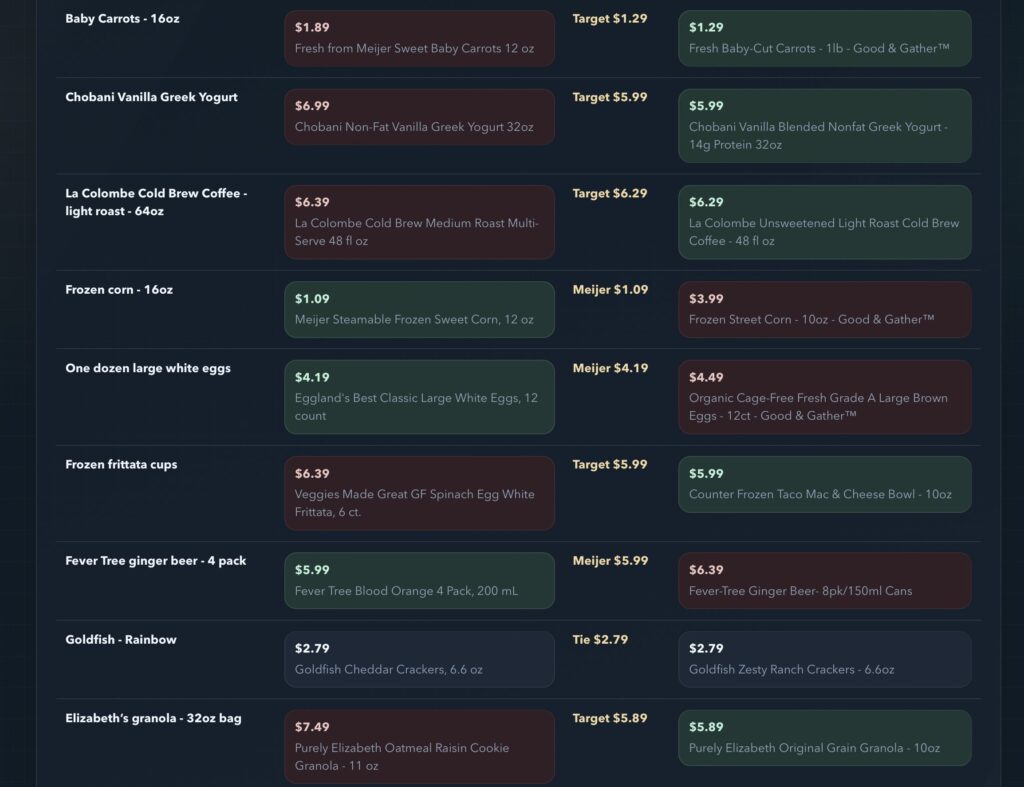
The site pulls the items from my master grocery list, compares the prices, and gives me a much faster sense of what should come from where.
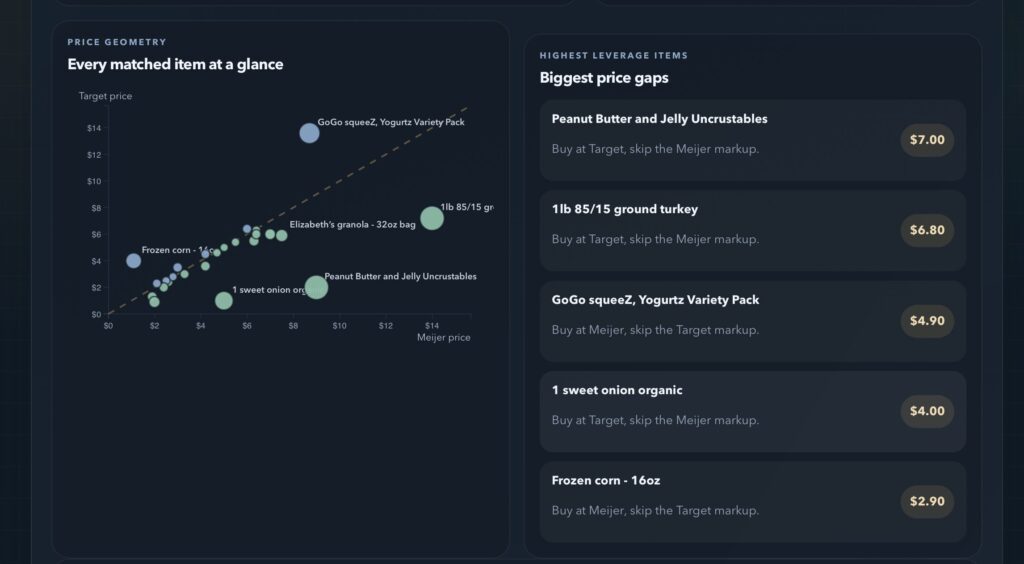
Right now it only compares Meijer and Target. It’s the first iteration and I kept it limited. Those are two of the places I shop regularly, and they were enough to make the tool useful immediately.
It is also not perfect. Product matching is messy in practice. Stores describe things differently. Sizes vary. Search results are not always clean. “Texas Toast” is a perfect example of the kind of item that exposes the edges of the system. Human beings can tell when two results are “basically the same thing” or when they are slightly off.
But even with those rough edges, the tool is already worth it.
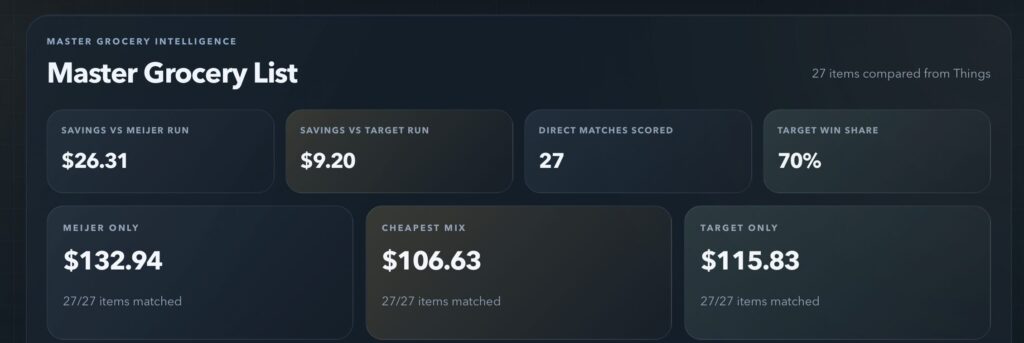
The funny part is how small the problem is
It’s not a startup idea or a sweeping productivity framework.
It’s definitely not one of those projects where you dramatically reinvent a category and then explain why everyone else has been thinking about groceries wrong.
It is a very ordinary household problem. And it speaks volumes.
A lot of the most useful software in a person’s life should probably be small, specific, and a little idiosyncratic. It should know something about your routine. It should remove friction from your week. It should earn its place by being helpful, not by pretending to be a platform.
That is exactly the kind of thing Codex is unexpectedly good at enabling.
People tend to talk about tools like Codex as coding accelerators, which is true but incomplete. The more interesting thing is that they lower the cost of building answers to narrow real-life annoyances. They make it much more reasonable to look at a problem that used to sit in the category of “annoying, but not worth building software for” and say: actually, maybe it is.
Now the overhead is lower, which means the range of solvable problems gets wider.
And not just work problems. Life problems.
Personal problems.
The kind of thing that lives in the background of your week and drains energy in small, unglamorous ways.
What I actually like about using it
The obvious benefit is money.
If the same list is cheaper at one store, or if certain items are clearly better bought at one place than another, I want to know that. Grocery prices are too inconsistent to leave that entirely to memory.
But the bigger benefit for me is time and mental relief. It cost me barely anything to make the app. Heck, it was actually pretty fun.
I even made a promo ad for it.
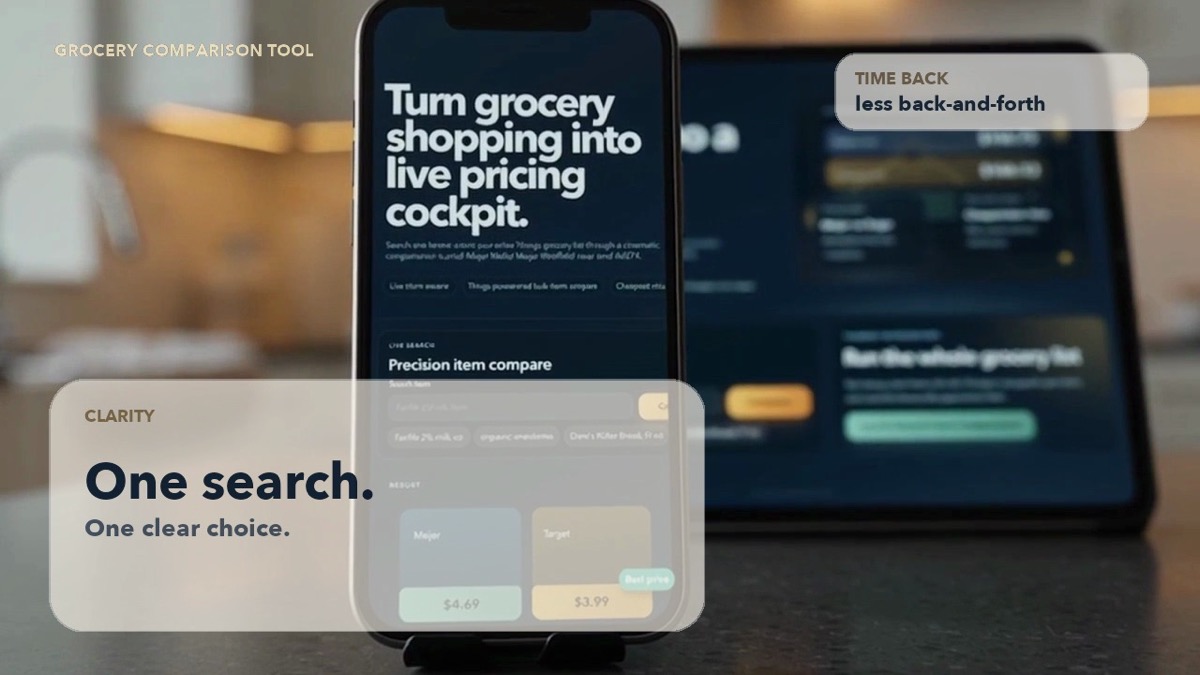
That still makes me laugh a little, because the underlying subject is so unglamorous. It is literally grocery optimization. But that is part of what I find compelling about this whole experience: Codex does not just help with the code. It helps make the idea real. It helps close the loop between problem, solution, interface, and presentation.
So instead of this project ending as “a script I run for myself,” it turned into something I could actually show.
The bigger point
Codex helped me build specific answers to real life much faster than I ever could.
My grocery comparison tool is narrow. It’s literally local. It’s wildly imperfect and hardly a novel idea.
And yet it is one of the most useful things I have built in a while.
I add items to Things. I run the site. It’s easy.
I get my answer faster. I make fewer unnecessary decisions. And grocery shopping becomes a little less annoying.
Still expensive as hell. But less annoying.
It’s nothing revolutionary. It’s barely more than a geeky side-quest.
But that is exactly why it matters.
Because it solves a problem I actually have, in a way that fits how I already live and it’s bespoke to me.
I think there is a lot of life in that category.
And I suspect I, and many others are going to keep building there.